What to do if you suspect you are a victim
Why symptoms are overlooked
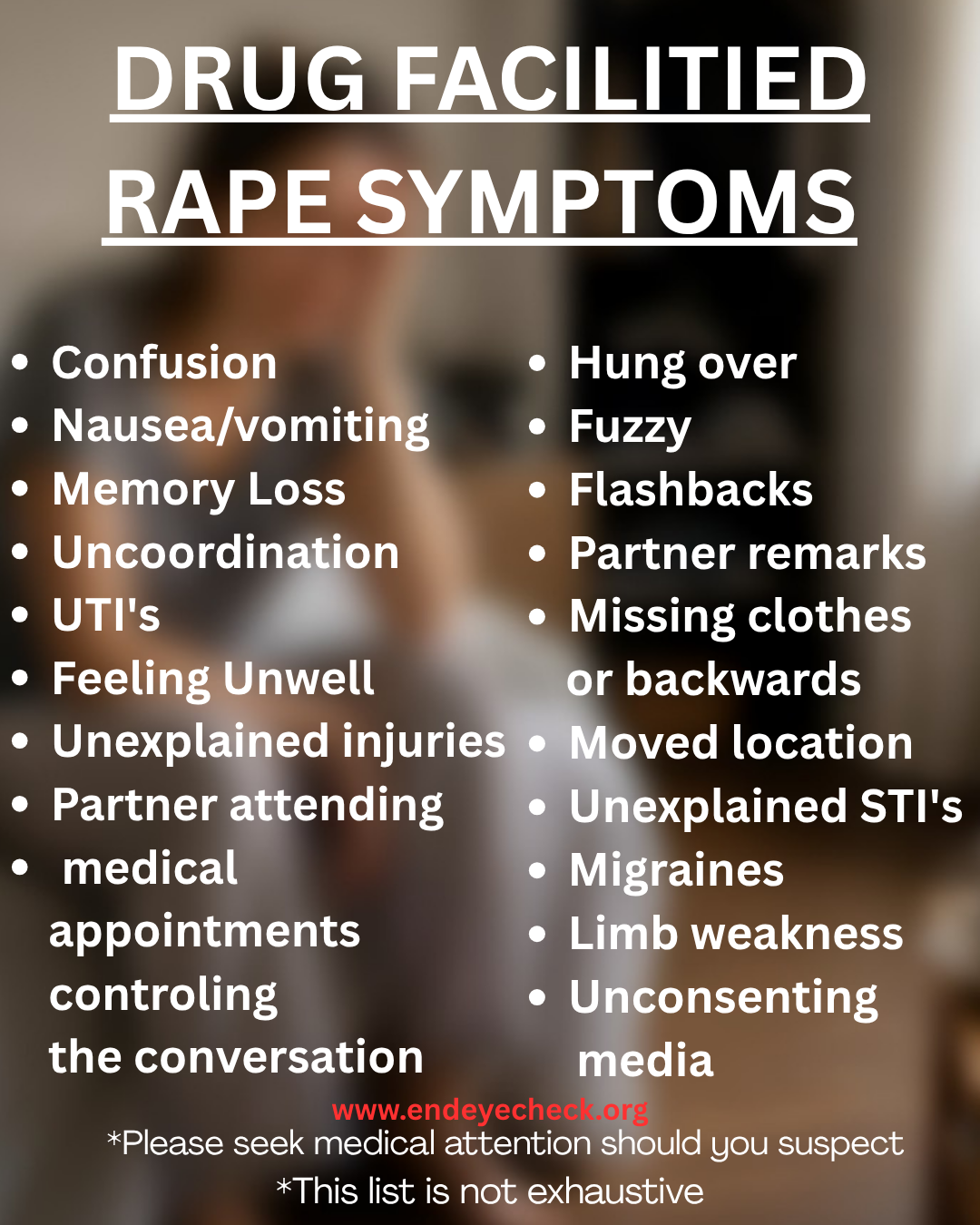
Drug-facilitated sexual assault (DFSA) symptoms are often overlooked because of how the drugs affect the body, memory, and behaviour, as well as societal misunderstandings about how these substances work.
Symptoms can be subtle with non-specific side effects.
Victims struggle to identify this as a crime at the hands of the man (perpetrator) that they trust and very often love. Victims may have experienced many happy years in a consensual sexual relationship with the perpetrator and are unable to comprehend the reality.
Self-blame and misappropriation of responsibility takes place. The victim often blames themselves and internalises the responsibility, typically questioning themselves, asking things like: “Was it my fault? I went to bed naked,” or “did I lead him on?” and “should I have had that wine?”
Not having a conscious memory of saying ‘no’ is not a ‘yes’ to sex. Being unable to fight back or say no diminishes the crime.
Often victims are concerned with having an inadequate response to the assault due to little or no memory. Fear of social stigma all play their part in minimalising this crime.
Survivor Support
Realising you have been affected by drug-facilitated sexual assault is rarely a sudden or immediate "lightbulb" moment. It is often a gradual, confusing, and deeply disorienting process.
Understanding why this realisation unfolds slowly can help make sense of the heavy emotional and cognitive fog that usually follows. Here is how that process often works:
Memory Gaps and Amnesia: Because the substances used (often referred to as date-rape drugs) frequently cause partial or total memory loss, confusion, or blackouts, there is no clear narrative of events. The mind is left trying to piece together a puzzle with missing pieces, which naturally takes time.
Physical Confusion vs. Memory: You might wake up with physical symptoms—such as extreme, uncharacteristic hangovers, severe fatigue, unexplained bruising, injuries, or a profound sense that something was deeply wrong—long before your mind can actually explain why or how it happened.
Cognitive Dissonance and Self-Doubt: The human brain often tries to protect itself from trauma by minimizing or rationalizing what happened. You might initially second-guess your own instincts, blame yourself for being tired or drinking, or assume you just had a "bad night," especially if you trusted the person or setting you were in.
The Shock and Dissociation Phase: In the days or weeks following an event, dissociation (feeling detached from your body or reality) is a very common survival response. Your brain may lock the experience away to keep you functioning, meaning the emotional impact and full realization might only surface much later when you feel safe enough to process it.
External Triggers: Often, a stray comment, a news story, hearing about someone else's experience, or encountering a similar environment can suddenly re-open the door to memories or feelings you didn't even know you were suppressing, shifting the realization into focus all at once.
If you or someone you know is trying to navigate these feelings, remember that it is entirely normal for your understanding of the event to evolve slowly, and you don't have to figure it all out alone.
Would you like some support resources or helpline links that can help talk you through this?
Support contacts